Why Bhagavad Gita AI Image Prompts Are So Popular
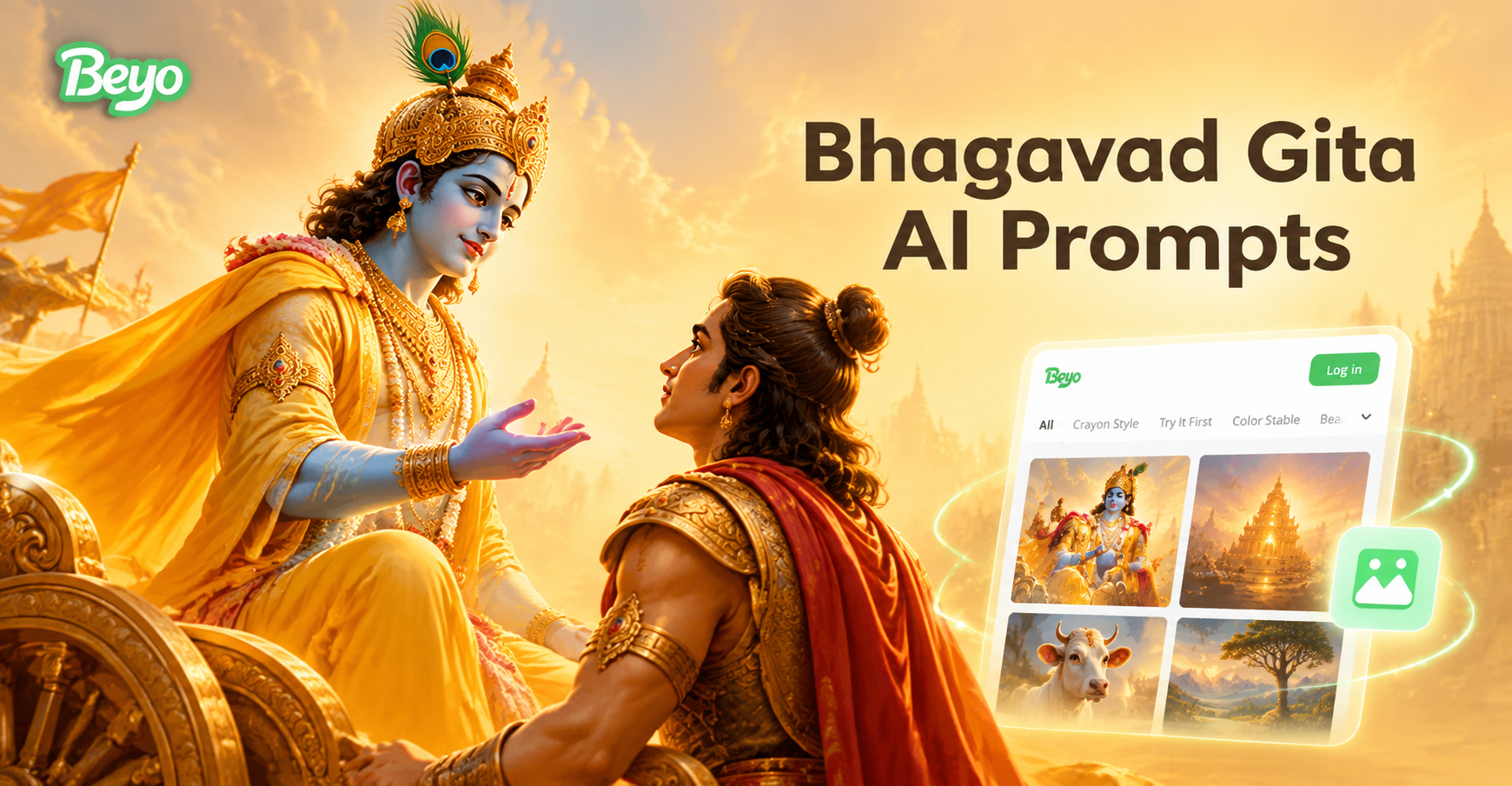
The Bhagavad Gita gives artists and devotional creators a rich visual language: Krishna as charioteer, Arjuna's moral struggle, the vast Kurukshetra battlefield, the cosmic Vishvarupa, conch shells, wheels, and peacock feathers. AI image generation turns these written scenes into detailed artworks when you provide the right prompts. This guide collects 25 specific Bhagavad Gita AI image prompts you can copy, adapt, and use inside an AI image app such as beyo.
These prompts are not vague descriptions. Each one names the subject, setting, composition, lighting, mood, and artistic style. That level of detail helps you get consistent, dramatic results instead of generic temple art.
25 Detailed Bhagavad Gita AI Image Prompts
Krishna and Arjuna on the Chariot
Prompt 1. A cinematic image of Lord Krishna as a calm charioteer standing on a golden chariot, holding white reins, speaking to Arjuna who kneels with a lowered bow. Kurukshetra battlefield at dawn, soft golden light, dust particles, epic oil painting style, highly detailed faces, 8K digital art.
Prompt 2. Close up portrait of Krishna with blue skin, gentle smile, peacock feather in his crown, yellow silk garments, standing beside Arjuna's chariot, warm sunlight, shallow depth of field, devotional art, soft glowing rim light.
Prompt 3. Arjuna sits inside a decorated war chariot, looking at Krishna with tearful eyes, bow and quiver beside him, horses with ornate bridles, dramatic cloudy sky, emotional realism, cinematic composition.
Prompt 4. Wide shot of Krishna's chariot with four white horses facing the Kaurava army, banners and conch symbols in the distance, Krishna holding a conch shell, morning mist, epic landscape, Indian miniature painting style with modern detail.
Prompt 5. Krishna gestures toward Arjuna while explaining the eternal soul, a glowing lotus floats above his palm, cosmic energy streams around them, night battlefield, stars and lightning, spiritual surrealism.
Divine Forms and Celestial Visions
Prompt 6. Vishvarupa, the universal form of Krishna, with multiple heads, arms, weapons, and cosmic galaxies inside his body, Arjuna shielding his eyes below, blazing light, divine aura, symmetrical composition, ultra detailed temple mural style.
Prompt 7. A serene image of Lord Krishna revealing the Bhagavad Gita as a glowing sacred book, golden Sanskrit letters floating around him, lotus petals falling, dark blue background, soft ethereal glow, spiritual digital painting.
Prompt 8. Krishna and Arjuna inside a cosmic bubble, the Gita's shlokas written in golden Devanagari across the sky, planets and stars, holy fire at the bottom, cinematic spiritual concept art.
Prompt 9. The sacred syllable Om glowing in the center, Krishna and Arjuna silhouetted in meditation on a hill, river and mountains behind, sunrise rays, tranquil atmosphere, watercolor and ink fusion.
Prompt 10. An otherworldly scene of Krishna's cosmic eye looking down at the Kurukshetra battlefield, reflected in the eye are warriors and chariots, photographic surrealism, deep blues and golds, divine judgment mood.
Prompt 11. A divine palace in the clouds where Krishna sits on a lotus throne, Arjuna bows before him, celestial musicians and apsaras float around, warm gold light, intricate Indian temple architecture, vibrant classical painting.
Kurukshetra Battlefield and Epic Moments
Prompt 12. Panoramic view of the Kurukshetra battlefield at sunrise, two ancient armies lined up with flags, elephants, horses, and chariots, Krishna's chariot in the center foreground, dramatic storm clouds, epic cinematic wide angle.
Prompt 13. A young Arjuna lifts his bow Gandiva while Krishna steers the chariot, arrows fly overhead, dust and embers, intense action shot, warm orange and blue color contrast, hyper realistic digital painting.
Prompt 14. Bhishma lying on a bed of arrows under a moonlit sky, Krishna and Arjuna standing nearby with folded hands, solemn atmosphere, soft blue night lighting, classical Indian art with emotional depth.
Prompt 15. The conch Panchajanya being blown by Krishna, sound waves visualized as golden ripples across the battlefield, warriors pause in awe, glowing divine energy, symbolic composition, detailed digital illustration.
Prompt 16. A lone chariot wheel with a broken spoke at sunset, Krishna's flute resting beside it, scattered petals and ashes, quiet aftermath mood, cinematic realism with a poetic touch.
Prompt 17. Arjuna's chariot exploding into light as Krishna withdraws his divine protection, horses and wheels dissolving into particles, dark dramatic sky, high contrast, fantasy digital art.
Symbolic and Meditative Imagery
Prompt 18. A meditating figure in saffron robes holding a bead necklace, a glowing blue Krishna appears behind him, a peacock feather and conch at his feet, peaceful ashram setting, soft mist, warm golden light, spiritual portrait.
Prompt 19. Close up of Krishna's hand holding a white conch with a red sun behind, water droplets, intricate henna patterns on the wrist, symbolic still life, high detail macro photography.
Prompt 20. A peacock feather lying on an open Bhagavad Gita book, a diya oil lamp glowing beside it, wooden table, dark background, right side soft light, devotional still life, realistic texture.
Prompt 21. An ash covered sadhu meditating under a banyan tree, the words of the Gita appear in golden smoke from a fire, Krishna's silhouette in the flames, moody spiritual atmosphere, oil painting.
Prompt 22. A warrior's helmet, a broken arrow, and a lotus flower arranged on a stone platform at Kurukshetra, soft rain falling, symbolic composition, muted earthy tones, cinematic storytelling image.
Prompt 23. The chariot wheel as a cosmic mandala with scenes from the Gita in each spoke, blue and gold sacred geometry, meditative symmetry, intricate line art and watercolor.
Artistic Styles for Bhagavad Gita Scenes
Prompt 24. A traditional Pahari miniature painting of Krishna speaking to Arjuna on the battlefield, flat perspective, ornate borders, red and gold background, small detailed figures, antique paper texture.
Prompt 25. A modern vector art poster of Krishna with a glowing crown, text Bhagavad Gita in bold Devanagari calligraphy, orange, teal, and gold palette, clean shapes, minimal background, high contrast graphic design.
Key Visual Elements for Bhagavad Gita AI Images
When you build your own prompts, include a few of these elements so the AI understands the setting. The conch shell represents the call to dharma. The chariot wheel represents time and action. The peacock feather identifies Krishna. The bow Gandiva identifies Arjuna. The battlefield represents inner conflict. The lotus represents detachment. Use these symbols in your prompts, and the images will feel more rooted in the Gita.
Color matters too. Warm golds, saffron, deep blue, and red are common in devotional art. For a more cinematic look, use teal and orange contrast. For a meditative mood, use soft blue, cream, and white. You can specify these color choices in the prompt itself.
How to Adapt These Bhagavad Gita AI Image Prompts
You can change one small part of any prompt to get a completely different result. Swap the style from oil painting to watercolor, pixel art, 3D render, or anime. Change the time of day from dawn to midnight. Add a color palette such as warm golds, deep blues, or monochrome sepia. If you want a portrait, remove the wide shot words and add close up, face focused. If you want a background for your phone, add vertical 9:16 composition.
It also helps to repeat the most important subject with extra detail. For example, if you want Krishna to be unmistakable, specify blue skin, yellow dhoti, peacock feather crown, gentle smile in every prompt. If Arjuna is the focus, specify young warrior, beard, armor, bow Gandiva, tearful eyes.
How to Improve Weak Results
A weak result usually comes from either too little detail or mixed subjects. If the AI blends Krishna and Arjuna into one figure, rewrite the prompt as two separate sentences. First describe Krishna, then describe Arjuna, then describe the interaction. If the image looks too generic, add a specific artistic reference such as Indian miniature painting, realistic cinematic still, or traditional Pattachitra style.
If the faces look distorted, move the subject closer in composition. Use words like close up portrait, only one face visible, or upper body. If the text in the image appears as gibberish, avoid asking for long Sanskrit verses. Ask for a single glowing Om symbol or simple calligraphy. Then use an editing tool if you need precise text.
Using Bhagavad Gita AI Image Prompts in the beyo App
These prompts work well inside the beyo mobile app. Open the app, choose an image generation style template, paste one of the Bhagavad Gita prompts, and generate. You can then adjust the prompt or switch styles if the first image needs refinement. The app includes many style filters, so you can reuse the same prompt with realistic, anime, 3D, watercolor, or cinematic effects without rewriting the whole description.
Conclusion
Bhagavad Gita AI image prompts give you a direct way to visualize one of the most beloved scriptures. Whether you need a Krishna portrait for a devotional poster, an Arjuna warrior scene for a story project, or a cosmic Vishvarupa for a phone wallpaper, the key is to be specific about subject, mood, and style. Use the 25 prompts above as starting points, adapt them to your own vision, and generate multiple variations until the image matches the spiritual depth you want.